


Rose Bay residents are raising concerns over 135 trees identified for potential removal across a single residential block, where several major developments threaten to reshape the neighbourhood’s mature canopy and intensify construction activity along Dover Road and Wilberforce Avenue.
In October 2026, community opposition has focused on a series of projects at different stages of approval, including a residential development approved in September, two substantial seniors housing proposals and an eight-storey apartment project. Residents are calling for a broader assessment of tree loss, basement excavation and groundwater impacts across the block bounded by Dover Road, Wilberforce Avenue and Spencer Lane.
Three sites account for 135 trees
A community campaign map identifies 135 trees proposed or approved for removal across three development sites. The figure combines tree counts drawn from planning material cited by residents, although the total has not been independently reconciled against all three projects’ latest arborist assessments and approval conditions.
At 23–31 Dover Road, public submissions identify 27 trees marked for removal. The NSW Department of Planning, Housing and Infrastructure approved the residential project, which includes affordable housing and basement parking, on 14 September 2026.


Another 14 trees have been identified by campaigners at 12–18 Wilberforce Avenue, where an application proposes demolishing existing houses to construct an eight-storey building containing 32 apartments above two basement levels. The application, DA 449/2025/1, is recorded by the Sydney Eastern City Planning Panel as returned to Council.
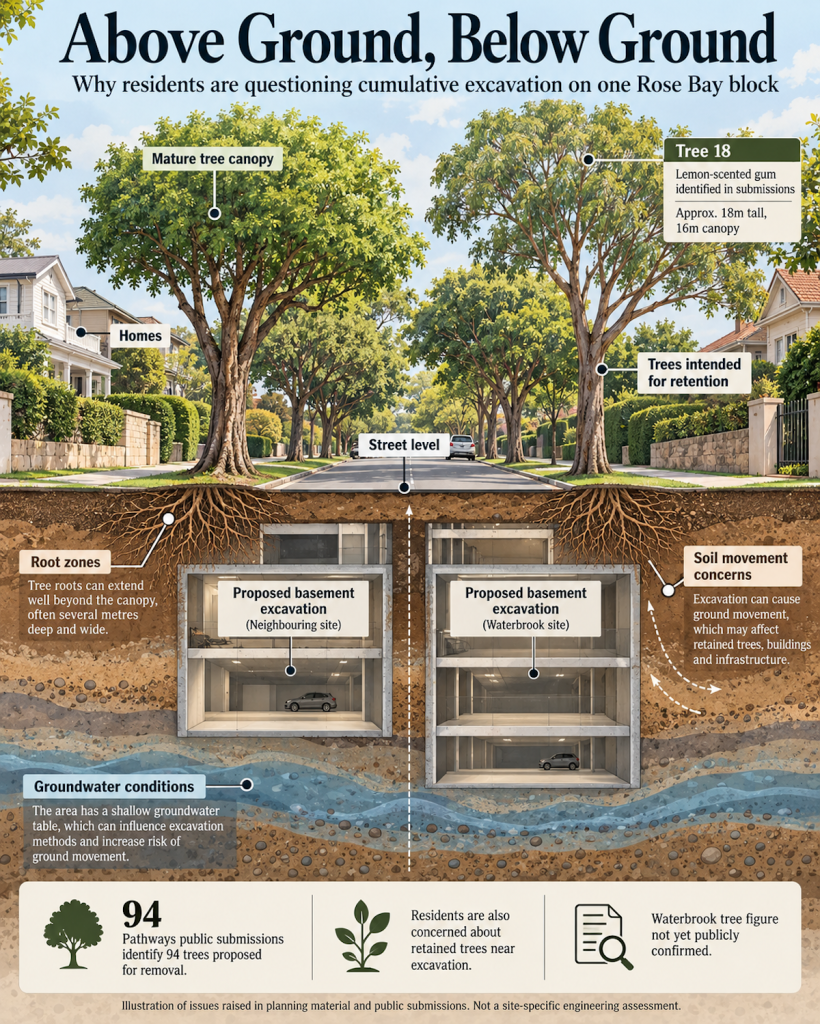
The largest reported loss involves the Pathways seniors housing proposal at 20–30 Wilberforce Avenue and 33–39 Dover Road. Public submissions identify 94 trees proposed for removal, including a mature lemon-scented gum known as Tree 18.
The tree, approximately 18 metres tall with a 16-metre canopy, has been described in submissions referring to the arborist assessment as having high landscape significance and high retention value. Residents have questioned its proposed removal to accommodate basement construction, citing the loss of established shade and habitat that replacement plantings would take years to provide.
Pathways proposes an eight- to nine-storey complex with approximately 70 independent living units and 50 residential aged-care rooms. Its state significant development application, SSD-100912708, remains at the response-to-submissions stage.
Waterbrook adds another major site
The proposed Waterbrook seniors housing development occupies another substantial portion of the same block, adding to residents’ concerns about the eventual scale of tree removal.
Waterbrook proposes an eight-storey development containing approximately 105 independent living units, 10 aged-care rooms and rooftop open space. Its environmental impact statement remains in preparation, with a confirmed tree-removal figure not yet available in publicly exhibited assessment documents.
The project, SSD-123064740, has therefore not been included in the campaign’s 135-tree calculation. Its forthcoming environmental assessment will provide further details about the site’s existing vegetation and proposed landscaping.
Basement excavation raises groundwater questions
Residents are also questioning the combined effects of deep basement excavations across neighbouring development sites, particularly in Rose Bay’s low-lying coastal environment.
Public submissions concerning Pathways describe a proposed two-level basement accommodating approximately 140 vehicles. Objectors have raised concerns about excavation through water-bearing soils, potential groundwater changes, settlement and vibration affecting nearby properties.
The submissions also identify possible disturbance of acid sulfate soils and damage to trees intended for retention. Campaigners fear that excavation near established root systems, together with altered soil and groundwater conditions, could affect trees beyond those earmarked for removal.
Several residents have requested cumulative geotechnical and groundwater assessments covering neighbouring developments, particularly where excavation and construction activities could overlap. The risks identified in submissions remain matters for technical assessment rather than established consequences of the proposed works.
Wilberforce car park redevelopment remains under review
Construction pressures around the block could also be affected by Woollahra Council’s planned redevelopment of the Wilberforce Avenue public car park.
The original development application received approval on 9 November 2023, but subsequent decisions changed the project’s delivery arrangements. Council has since pursued a public-private partnership for a facility providing at least 200 public parking spaces, 500 square metres of community space and public toilets.
In an update dated 31 August 2026, Council reported that it was reviewing a detailed proposal from developer Perifa. The project is intended to improve public parking and community facilities in Rose Bay.
Across the wider block, residents have raised concerns about construction traffic, pedestrian safety and congestion near Rose Bay Public School, particularly during morning drop-off and afternoon collection periods.
Housing growth puts tree protection in focus
The redevelopment proposals come amid wider changes to residential planning controls under the NSW Government’s Low and Mid-Rise Housing Policy, which allows additional housing in eligible areas close to nominated centres and transport hubs.
Rose Bay town centre is among the locations covered by the reforms, which aim to increase housing supply and choice in established neighbourhoods. The developments around Dover Road and Wilberforce Avenue are proceeding through different planning pathways, including state significant development assessments and a local development application.
Woollahra Council has opposed aspects of the housing reforms, raising concerns about infrastructure capacity, environmental protection and neighbourhood character.
Residents call for block-wide assessment
The community campaign is urging planning authorities to consider the combined environmental effects of development across the entire block, rather than relying solely on assessments prepared for individual properties.
Its concerns extend beyond the trees proposed for removal to the survival of retained vegetation, changes in groundwater conditions, construction traffic and the cumulative disturbance caused by adjoining projects.
The Pathways assessment remains ongoing, while Waterbrook’s environmental impact statement has yet to be exhibited. Both processes remain central to determining how much of the block’s existing canopy could be affected by the proposed redevelopment.
Published 12-Oct-2026